Claude Sonnet 4.6: Our Most Capable Sonnet Yet
Claude Sonnet 4.6 is a full upgrade across coding, computer use, long-context reasoning, agent planning, knowledge work, and design. Features a 1M token context window in beta.
This lesson is original educational writing based on this video by Anthropic (published February 17, 2026). All credit for the original content goes to the creators.
1. What Changed in Sonnet 4.6
Anthropic releases Claude models in a three-tier family. Haiku is the fastest and most cost-effective tier, optimized for tasks where speed and volume matter more than depth. Opus is the most capable tier, built for the hardest problems where raw reasoning power is worth paying for. Sonnet sits in the middle: it is designed to be the best model at the balanced tier — smart enough for demanding work, fast and affordable enough to use routinely. Sonnet 4.6 is a significant step forward for that balanced tier across essentially every capability dimension.
Coding is perhaps the most immediately noticeable improvement. Sonnet 4.6 writes code that is more correct on the first attempt, handles larger and more complex codebases without losing track of context, and is substantially better at debugging — not just identifying the error but understanding why it occurred and what the correct fix is. This matters enormously in agentic coding workflows like Claude Code, where the model is editing real files in a real repository and a hallucinated fix creates a regression. The improvement in coding reliability makes Sonnet 4.6 more suitable for unattended or lightly supervised coding tasks than any previous Sonnet release.
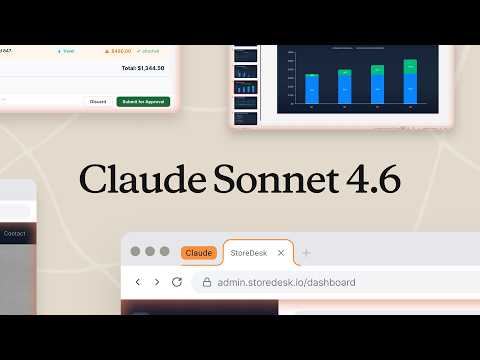
Computer use — Claude’s ability to operate a desktop graphical interface by understanding screenshots and issuing click, type, and scroll instructions — improved significantly. The model is better at navigating real-world UIs that are messy, inconsistent, or have visual elements that require interpretation rather than simple pattern matching. It handles multi-step workflows more reliably, is less likely to get stuck in loops, and recovers more gracefully when an unexpected dialog or state appears on screen. Computer use remains a capability that requires careful orchestration, but the underlying model quality has taken a meaningful leap.
Long-context reasoning improved both in raw capability and in what the model does with very long inputs. Claude has always had a large context window by industry standards, but the quality of reasoning over long documents — the model’s ability to track arguments, spot contradictions, synthesize across sections that are far apart in the text — has improved. This is relevant for tasks like analyzing a lengthy contract, reviewing a large codebase, or synthesizing a research body spread across dozens of documents.
Agent planning is the improvement that matters most for developers building autonomous AI systems. When a model is given a complex, multi-step goal and a set of tools, the quality of its planning — how it sequences actions, decides when to gather more information versus act, and handles partial failures — determines whether the agent actually completes the task or wanders off into an unrecoverable state. Sonnet 4.6 plans more coherently, reconsiders plans when they fail, and completes longer task sequences without intervention.
Design is a less commonly discussed dimension, but Sonnet 4.6 is genuinely better at tasks involving visual and aesthetic judgment — designing user interfaces, writing CSS, critiquing layouts, and producing creative work that requires both technical execution and good taste. For developers building frontend tools or creative applications, this is a meaningful improvement.
2. The 1M Token Context Window
The single most dramatic specification change in Sonnet 4.6 is the introduction of a one-million token context window, currently available in beta. To appreciate why this matters, it helps to translate tokens into concrete terms. One million tokens is roughly 750,000 words, or about 1,500 pages of text. A long novel is around 150,000 words. A moderately large codebase with several hundred source files might have 300,000–500,000 tokens of content. A day’s worth of meeting transcripts, email threads, and documents is typically well under 100,000 tokens.
Put plainly: the 1M token context window means that for most real-world tasks, you can include essentially everything relevant without worrying about what to leave out. You can drop in an entire codebase. You can include a full legal contract corpus. You can feed in months of customer support transcripts. You can concatenate all the research papers relevant to a question and ask Claude to synthesize across all of them at once.
The value here is not just about volume — it is about what becomes possible when the model can hold all the relevant context at once rather than a curated subset. Many analysis tasks today require careful preprocessing to select and compress the right information before feeding it to the model. That preprocessing step is itself error-prone and lossy. With 1M tokens, the preprocessing step shrinks dramatically or disappears. You include everything and let the model reason about what matters.
There are important caveats. The 1M context window is in beta, meaning it may have rough edges and is not yet recommended for all production workloads. Very large context inputs have higher latency and cost — you are processing more tokens on both input and output reasoning sides. For tasks where the relevant content is genuinely compact (a single document, a short code file, a brief question), a large context window provides no benefit and adds unnecessary cost. The skill is knowing which tasks actually require large context and which only seem like they do.
The most compelling use cases for 1M token context are: repository-level code analysis (understanding how a large system fits together), corpus-level research synthesis (finding patterns across many documents), long-form document review (analyzing a contract alongside all referenced exhibits and amendments), and extended agent sessions (maintaining a very long conversation and action history without truncation).
3. Choosing the Right Model: Haiku, Sonnet, or Opus
Anthropic’s three-tier model family is a genuine architecture decision, not just marketing segmentation. Each tier makes real trade-offs, and choosing correctly saves money while maintaining quality.
Haiku is optimized for speed and volume. It processes requests faster and costs significantly less per token than either Sonnet or Opus. The right cases for Haiku are tasks where the work is simple and well-defined, where you are processing high volumes of short requests, or where latency is the primary constraint. Classification tasks, simple summarization, structured data extraction from clean inputs, real-time chatbot responses — these are Haiku territory. If a capable human assistant could do the task in a few seconds with no background knowledge required, Haiku is probably sufficient.
Sonnet 4.6 is designed to be the best model you can use routinely for demanding work. It is the workhorse tier: capable enough to handle coding, analysis, multi-step reasoning, and agent workflows with high quality, while still being fast and affordable enough to use as the default model for most applications. If you are building a production application and are unsure which tier to start with, start with Sonnet 4.6. Its cost-to-capability ratio is the best in the family for the broad middle of the work that engineers, analysts, and knowledge workers actually do.
Opus is for the hardest problems — the ones where Sonnet 4.6 produces answers that are good but where you need answers that are the best possible. Complex multi-hop reasoning, frontier research synthesis, sophisticated argument construction, tasks where quality is so critical that the higher cost and slower latency are worth paying. Opus is not an everyday tool; it is the model you reach for when the task is genuinely hard and the stakes are high.
For pricing, the tier structure reflects the capability and compute cost differences. Haiku is the cheapest; Opus is the most expensive; Sonnet sits between them. As of the Sonnet 4.6 release, the Sonnet tier’s capability-to-cost ratio improved — you get substantially more capability per dollar than you did with earlier Sonnet versions, because the model improved without a price increase.
Check your understanding
4 questions · your answers are saved in this browser only
-
1. Which capability improvement in Sonnet 4.6 is most significant for developers building autonomous AI agents?
-
2. Approximately how much text can fit in a 1M token context window?
-
3. A team is building a real-time customer support chatbot that answers simple questions about a product. The questions are short, the answers are well-defined, and the system handles thousands of requests per hour. Which Claude model is the best default choice?
-
4. What is the main practical caveat about the 1M token context window in Sonnet 4.6?
Build it yourself
Follow these exact steps to reproduce it yourself · estimated time: ~15 min
Prerequisites
- An Anthropic API key (set as ANTHROPIC_API_KEY in your environment)
- Python 3.10+ or Node.js 18+ installed
- The Anthropic SDK installed: pip install anthropic or npm install @anthropic-ai/sdk
Step 1 — Make your first Sonnet 4.6 request
The simplest way to experience Sonnet 4.6 is a direct API call. The model ID is claude-sonnet-4-6:
import anthropic

client = anthropic.Anthropic()

response = client.messages.create(
    model="claude-sonnet-4-6",
    max_tokens=1024,
    messages=[
        {
            "role": "user",
            "content": "Explain the trade-offs between a hash map and a balanced BST for a use case where reads are 100x more frequent than writes."
        }
    ]
)

print(response.content[0].text)
Run this and compare the output to what you have seen from earlier Sonnet versions. The reasoning quality on technical questions like this is one of the most visible improvements.
Step 2 — Test the coding improvement
Ask Sonnet 4.6 to write and debug a non-trivial piece of code. A good test is asking it to implement a data structure with specific constraints:
response = client.messages.create(
    model="claude-sonnet-4-6",
    max_tokens=2048,
    messages=[
        {
            "role": "user",
            "content": """Write a Python LRU cache implementation that:
1. Has O(1) get and put operations
2. Is thread-safe using a lock
3. Has a configurable max size
4. Includes a method to inspect the current cache state (for debugging)
5. Includes unit tests for all four methods

Do not use functools.lru_cache or any other library LRU implementation."""
        }
    ]
)

print(response.content[0].text)
Evaluate whether the output is correct, handles edge cases, and actually implements thread safety properly (a common place where weaker models get it wrong).
Step 3 — Explore long-context reasoning
To experience the 1M context window, try feeding Sonnet 4.6 a large document and asking it to reason across the full content. A practical test is analyzing a long codebase or a lengthy document:
import os

# Load a large text file (e.g., a codebase concatenated into a single string)
# For testing, you can use any long text — a book, a large source file, etc.
with open("large_document.txt", "r") as f:
    document = f.read()

response = client.messages.create(
    model="claude-sonnet-4-6",
    max_tokens=2048,
    messages=[
        {
            "role": "user",
            "content": f"""Here is a large document:\n\n{document}\n\n
Based on the full document, identify:
1. The three most important themes or patterns
2. Any internal contradictions or inconsistencies
3. The key assumptions the author makes that are never explicitly stated"""
        }
    ]
)

print(response.content[0].text)
Note: For very large documents (hundreds of thousands of tokens), the beta 1M context window must be enabled on your account. Check the Anthropic documentation for current beta access instructions.
Step 4 — Build a simple model tier router
Implement the routing strategy described in the lesson — use Sonnet 4.6 by default, escalate to Opus for tasks that fail a quality check:
import anthropic

client = anthropic.Anthropic()

def quality_check(response_text: str, task_type: str) -> bool:
    """Simple heuristic quality check — replace with task-specific logic."""
    if task_type == "code":
        # Check that the response actually contains code
        return "```" in response_text and len(response_text) > 200
    if task_type == "analysis":
        # Check that the response has substantial content
        return len(response_text.split()) > 100
    return True  # Default: accept the response

def smart_complete(prompt: str, task_type: str = "general") -> str:
    # Try Sonnet first
    sonnet_response = client.messages.create(
        model="claude-sonnet-4-6",
        max_tokens=2048,
        messages=[{"role": "user", "content": prompt}]
    )
    sonnet_text = sonnet_response.content[0].text

    if quality_check(sonnet_text, task_type):
        print("[Used Sonnet 4.6]")
        return sonnet_text

    # Fall back to Opus
    print("[Escalating to Opus]")
    opus_response = client.messages.create(
        model="claude-opus-4-5",
        max_tokens=2048,
        messages=[{"role": "user", "content": prompt}]
    )
    return opus_response.content[0].text

# Test it
result = smart_complete(
    "Write a Python function that implements Dijkstra's algorithm with a min-heap.",
    task_type="code"
)
print(result)
Checkpoint: You now have hands-on experience with Sonnet 4.6’s coding quality, an understanding of how to work with large contexts, and a working model tier router you can adapt for production use.